Why Web3 got stuck on-chain, AI agents are hitting a wall, and the unbounded state machine is the only way forward.
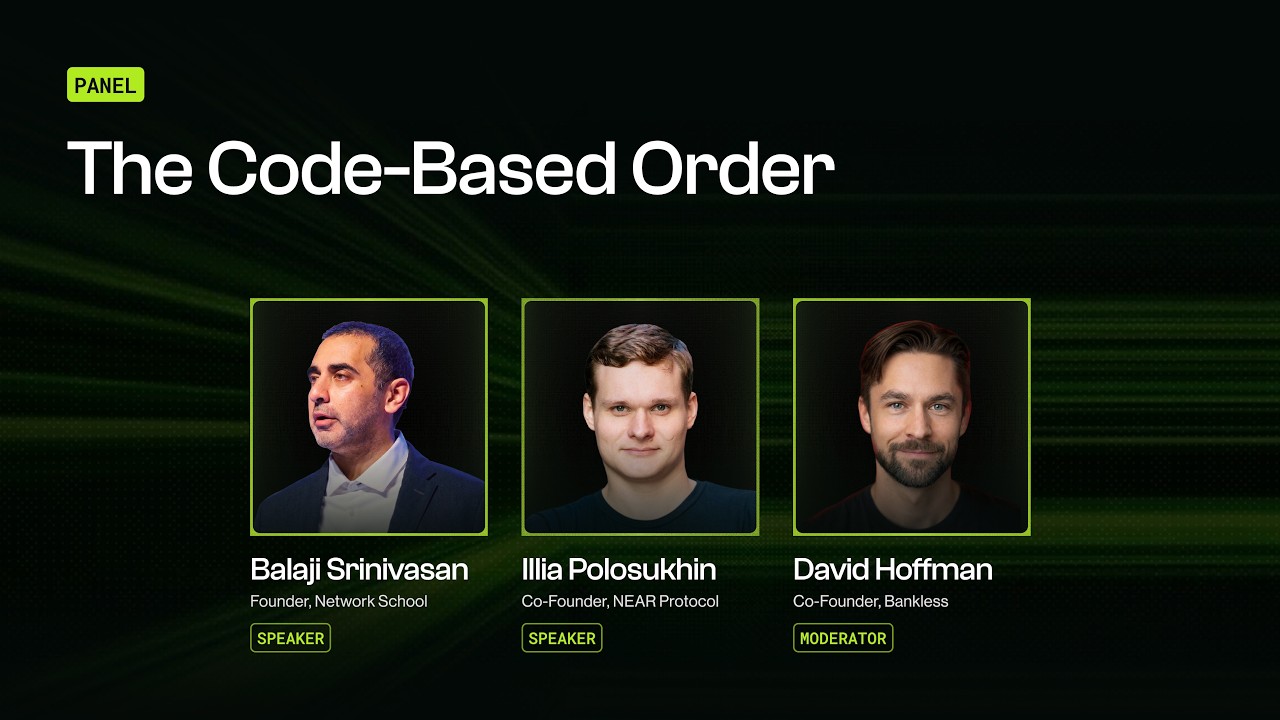
At a recent conference, Balaji Srinivasan argued that “AI makes everything fake, crypto makes it real again.” He predicted that because AI creates infinite spam, the internet will fracture into cryptographically gated digital borders. We will retreat into trusted tribes.
He is right about the diagnosis, but his solution is just a defensive wall.
Meanwhile, on the other side of the world, civic designer Indie Johar is looking at the physical realm and seeing a similar collapse. He points out that we are facing an “optionality collapse”—climate breakdown and complex supply chains are outpacing the ability of top-down bureaucracies to manage them. Johar notes that behind everything we build, there is “dark matter”: invisible rules, norms, and liabilities.
Both Balaji and Johar are describing the same crisis. Our systems for coordinating reality are failing. But the answer is not digital borders, and it is not just “decentralization.” As Johar says, “Decentralization is not enough. Re-entanglement is enough.”
To re-entangle society, we don’t need the world on-chain. We need the world On-state.
For a decade, the crypto industry has been obsessed with the “chain” (the database) and the “token” (the object). But the real invention, the one that changes how humanity coordinates, is the state machine.
The Anatomy of a State Machine
In computer science, a state machine is a mathematical model of a system. It’s simple: there is a current state, a set of rules for how that state can change, and an initial state where it all begins.
In a blockchain, the state is the shared reality that the network agrees upon. It is the exact configuration of the database at a specific block height. Because blockchains are deterministic, everyone must arrive at the exact same state using the exact same transition rules.
The size, depth, and rules of this state dictate what you can build on top of it. And for the past 15 years, the state has been extremely thin.
Look at Bitcoin. Its state is just two fields: an address, and a balance. address → balance. Bitcoin is a highly secure, globally synchronized clock that maps public keys to numbers.
When Satoshi wrote the whitepaper, the address was designed to represent a cryptographic lock. You own the private key, you can move the balance. But the industry made a cognitive error. We assumed the address was “identity.”
It is not. An address is just a keyhole. As Johar points out, identity is not a single point or a boundary. “Identity is an approximation of relational density.” A wallet address has no relationships, no history, and no context. It is a keyhole, not a person.
Because Bitcoin’s state is so thin, it can only do one thing: transfer value. It is a perfect tool for digital gold, but it cannot represent identity, reputation, or complex coordination.
Ethereum took a massive leap forward. By adding code and storage, it expanded the state to address → (balance, code, storage). This allowed us to build smart contracts and complex financial applications. But it is still an object-oriented state. It stores static assets and logic, but it still does not store people. The address remains an empty keyhole.
The Epicycles of Thin State
In a recent podcast, Jesse Walden, founder of Variant, noted that crypto’s ownership thesis worked beautifully for quantitative things, hash rate, DeFi liquidity, but failed for qualitative things like social networks and content. He pointed out: “AI enables us to measure things that are subjective or qualitative. Crypto has not successfully done this on its own.”
Why did crypto fail? Because the state machine is too thin. You cannot write a mechanism that rewards accurate curation or long-term mentorship if the state machine doesn’t know who the curators or mentors are.
Because the state was thin, we were forced to rely on fragile external workarounds to simulate the missing context:
We built oracles to pull off-chain data onto the chain. But an oracle is just a trusted third party in disguise, reintroducing the centralization we tried to escape. We built APIs to interact with the state, but APIs are gatekept doorways. And because the state couldn’t enforce complex rules, we handed control of billions of dollars to anonymous multisigs—replacing visible bureaucracies with invisible cabals.
We tried to build a society on an architecture that could only represent objects.
The AI Agent Delusion
Today, the industry is pivoting toward AI agents. We are told that agents will automate everything and collapse the cost of composability. But if you look closely, agents are hitting a structural wall.
An AI agent is currently just a script calling an API. If an agent wants to buy something, negotiate a contract, or build a reputation, it has no persistent identity. It cannot prove it is distinct from a swarm of a million spam bots.
As Illia Polosukhin, co-founder of NEAR, noted: “AI is great to effectively DDoS all of the legal system… You need to apply sybil resistance.” APIs are being spammed because they cannot verify who is calling them.
And this isn’t just about spam. In her essay on formal verification, Lisa Akselrod explains why this is so dangerous. Formal verification is the process of using math to prove that a system cannot break certain rules. You define a “forbidden state” (e.g., an agent draining a treasury) and you prove mathematically that no sequence of valid steps can reach it.
Akselrod notes that AI agents act non-deterministically at machine speed. If there is a path to a forbidden state, an AI agent will eventually find it. It doesn’t have to be malicious; it just explores the state space at a speed humans cannot match. It will chain together a sequence of legally valid API calls until it accidentally drains the vault.
APIs and off-chain databases cannot prevent this because they are not unified state machines. If we want AI agents to have true autonomy, they need a state machine that can hold them accountable.
Bounding the Intersubjective Consensus Problem
The reason we haven’t moved to a richer state machine yet is because of the “Intersubjective Consensus Problem.” How does a deterministic state machine know if an off-chain event happened? How does it know if a claim is true?
We tried to solve this with APIs and oracles. But the problem is impossible to solve if you keep it fuzzy.
To solve it, we must bound the problem. We stop trying to make the blockchain magically know everything. Instead, we anchor the state to Actors who sign their claims, creating verifiable cryptographic provenance.
An Actor is not an address. An Actor is a persistent identity with a Lifeline—a continuous, verifiable record of actions, relationships, and history. When an Actor signs a claim, it is no longer a free-floating data point. It is a state transition bound to a specific, accountable entity.
The On-State Paradigm
This is the evolution from Web3 to Web4.
We are moving from a world of static objects and isolated APIs to a world On-state. A single, synchronized state machine that models the actual complexity of human and machine coordination.
Society Protocol is building this architecture. It expands the state machine from address → balance to:
Actor → (identity, history, relationships, Energy, Property, Governance)
By storing identity as a relational density—the Actor and its Timeline—we unlock the ability to measure qualitative, subjective value. By storing Actors instead of just Objects, we give AI agents a bounded, accountable environment in which to operate.
Indie Johar talks about the need for “re-entanglement.” Society Protocol is exactly that. It doesn’t just fragment power; it weaves identity, history, and value back together into a single synchronized state.
We confused the database with the civilization. The future of the internet isn’t about putting every transaction on a blockchain, and it isn’t about building walled gardens protected by APIs.
It’s about upgrading the state machine so that society itself can be coordinated. It’s time to put the world On-state.
Sources: