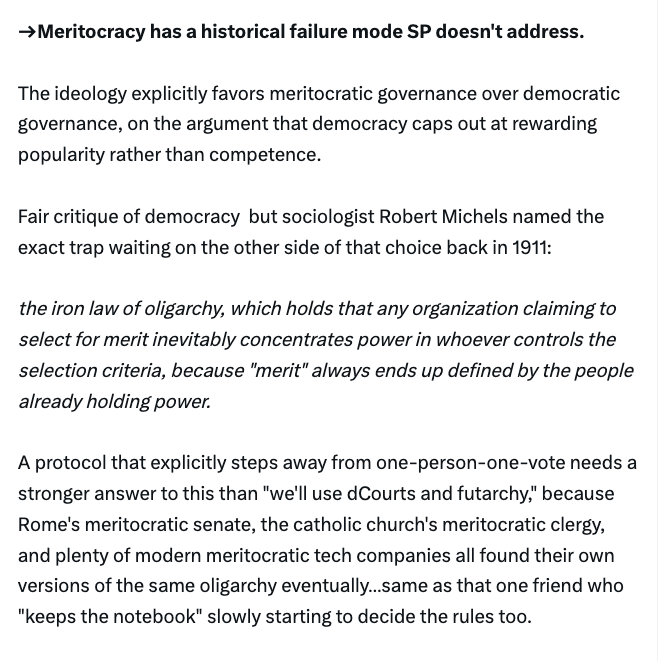
Critical Issue: Meritocracy
Many people have critiques of meritocracy, not because it’s flawed in theory, but rather because it gets corrupted in practice.
I’ve never personally seen one that is a theoretical issue in nature.
Therefore, we will assume, until pushback arrives, that meritocracy is the optimal theoretical system, and deal with the realistic divergence of implications & implemntations when implementing it in practice.
My Thoughts
Meritocracy is theoretically the optimal form of governance because a collective gets: the most high quality decisions, using the least amount of effort.
What’s kept it back during the current and past ages has to be identified––which is that “something always has to define what merit is and who has merit,” and the status games that go along with that. Meaning, no one individual is incentivized to define merit optimally for the group, they’re going to define merit however is optimal for them––and our collective groups have never had a suitable technology to easily facilitate an aggregation of these “subjective opinions of what has merit” into a collective answer at scale and speed…therefore, any definitions of meritocracy which emerged during the DEAA became corrupted by “whoever controlled the merit.”
This usually meant some form of guilded specialists took control of the definition of merit (and subsequently corrupted it to execute their will’s bidding). Groups of academics, politicians, secretive clubs, any subgroup or individual who was put into a position to define merit, we put above the rest (and they’re both participants and infrastructure in this game) so they exploit this power, and the idea of meritocracy gets corrupted.
What changes in Synchronized States and Society Protocol which would make meritocracy work as and resolve these issues?
-
We have a group-wide Synchronized Social Contract (SSC). That means the whole society can affect the definition of merit, to get a more accurate definition) (this wasn’t feasible before).
-
The root feature of the DEAA’s accounting systems is: duplicated contracts, and the base required assumption for these to function is that “everyone is equal participants.” This structure CANNOT, at a systematic level, handle the differences between individuals (everyone must be treated as equal participants).
-
A Synchronized State CAN handle these differences in individuals unique histories through its accumulated immutable timeline. The analytics made available by the immutable history nature of Synchronized States. The public Timeline will make all Actor’s histories verifiably accurate to the collectives perception, and both singular and unique for all participants.
-
The instant synchronized governance abilities, mean that no in-groups, must be formed to define meritocracy. The entire collective can define, and continuously adjust merit while using the single chronological Timeline, without any players individually or as a sub-group gaining an innate advantage in this “status game”, which in all past ages is not feasible.
-
If the meritocratic state of affairs is corrupted. Exiting (through forking or Portal) is easier than in the past ages.
I expect all of these together to equal the ability to partake in a meritocracy and that to become the dominant governance structure of the TEAA. If this happens, it will spread society-wide, and humanity will benefit by attaining closer to theoretically perfect group decision-making.
Video Answer (Time: 4:53 – 19:55)