Subject
- How are the powers to change the rules defined and delineated? (Governance structure)
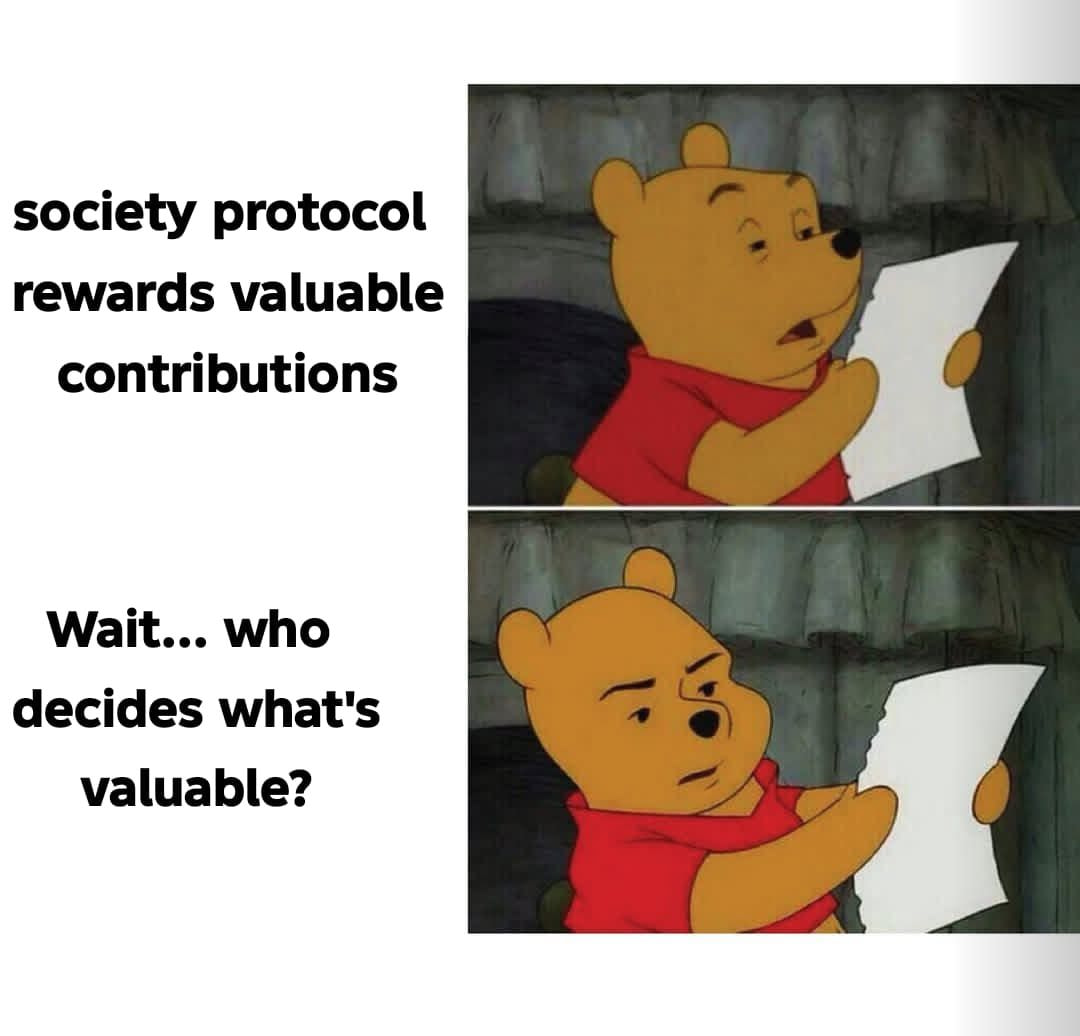
- Who makes the rules and decides what’s valuable?
- How are they changed and updated across the system? (Governance agility)
Whoever can re-write the rules, can ultimately control the entire system. Thi is the top-level power dynamic in Synchronized States outside of the (social layer) exit dynamics.
We cannot stop the need for the ruleset’s (SSC) need to be written and updated. So, some entities must have the power and responsibility to do this.
It’s extremely important that whoever writes the rules is:
- The optimal participants to do so in the best way for the collective. This topic is dealt with more in Critique Topic: Governance Capture.
- They have the ability to write and update rules in an adaptive, agile, and secure fashion to make important changes, and oftentimes with safeguards and oversight included.
Governance Structure
In Society Protocol, the Governance powers is broken down into Governance Domains.
More information about the Governance Domains can be found in the Governance section of the handbook.
Each Governance Domain only has access rights to change it’s specified portion of collective ruleset and state inside of a Synchronized State. Each Governance Domain has a criteria of who can change the parts it controls, change itself, and how they can do so. All the details are described in the Governance section of the handbook.
To create more precise definitions of control within the protocol, we could conceivably create more Governance Domains, or split the existing ones into sub-sections. Within each one, we can implement any programmable governance structure, using all the objects in the system, we desire.
Of these domains, the one that controls the Value Functions and Energy is “Protocol Parameters.” It’s powerful enough to ruin the Synchronized State for everyone, so we can use it as an example. It is still constrained by two things: itself (how it can make changes), and the Constitution.
Society Protocol doesn’t prescribe who decides what is valuable. Each Society Protocol instance sets up their parameters of who controls, how they can update rules and state, and what it takes to alter these domains.
We are simply trying to find the optimal structures for collectives to do so.
Each instance is responsible for initially programming, and updating throughout its lifetime, who exactly controls these important parameters and how they’re structured. This all functions essentially the same way that governance systems do today, except in a more “code is law” dynamic.
Any programmable tactics using the objects in the system can be used:
-
Requiring a supermajority of Energy threshold (any percentage)
-
Timelocks
-
Requiring approval of an enshrined council of arbiters (internal or external to the Synchronized State)
-
Restrictions on only being able to change Value Functions by certain small increments or percentages at a time (these Laws can be added in the Constitution, which is a different Governance Domain)
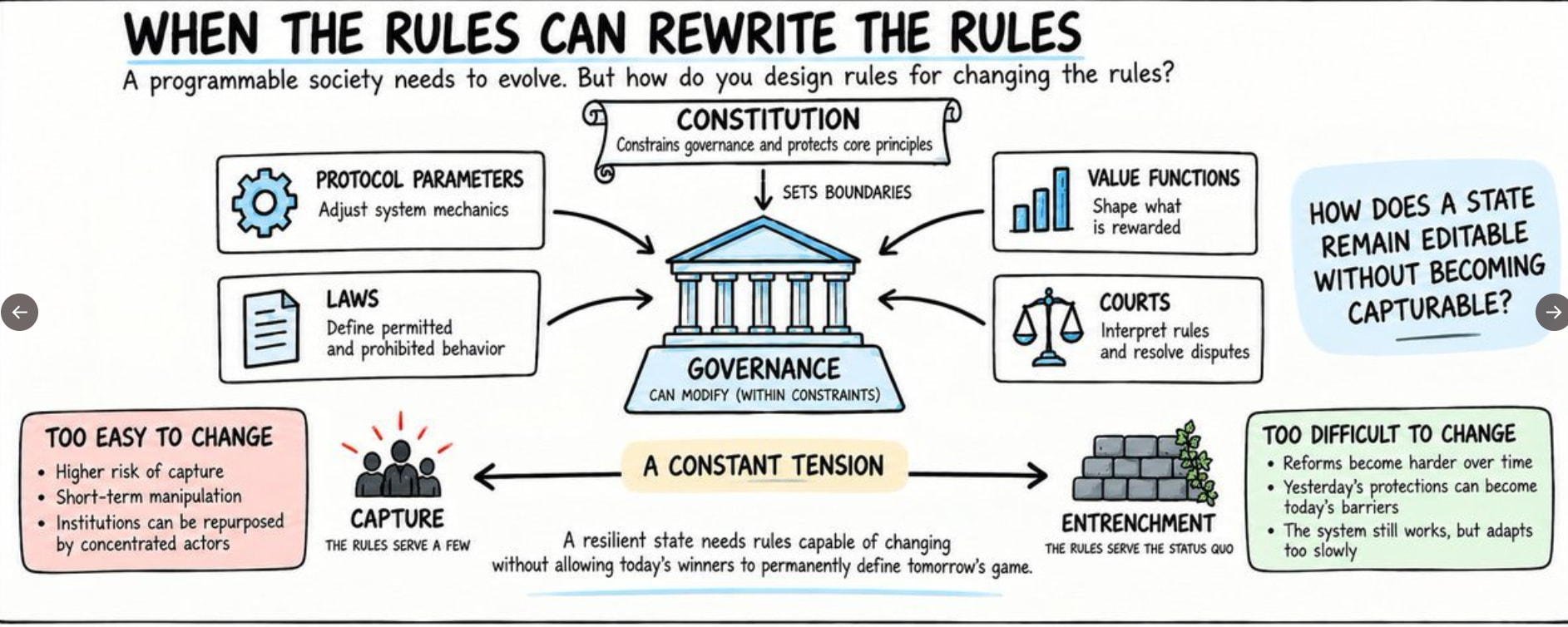

It all comes down to governance, in EVERY organization in history. Governance is like the brains of the collective (it’s group decision-making). Without the brain, the body can’t live. It’s the same for all collectives, but not all brains are equal, and it’s amplified in Synchronized States (the power, agility, and also danger of mistakes).