My Thoughts
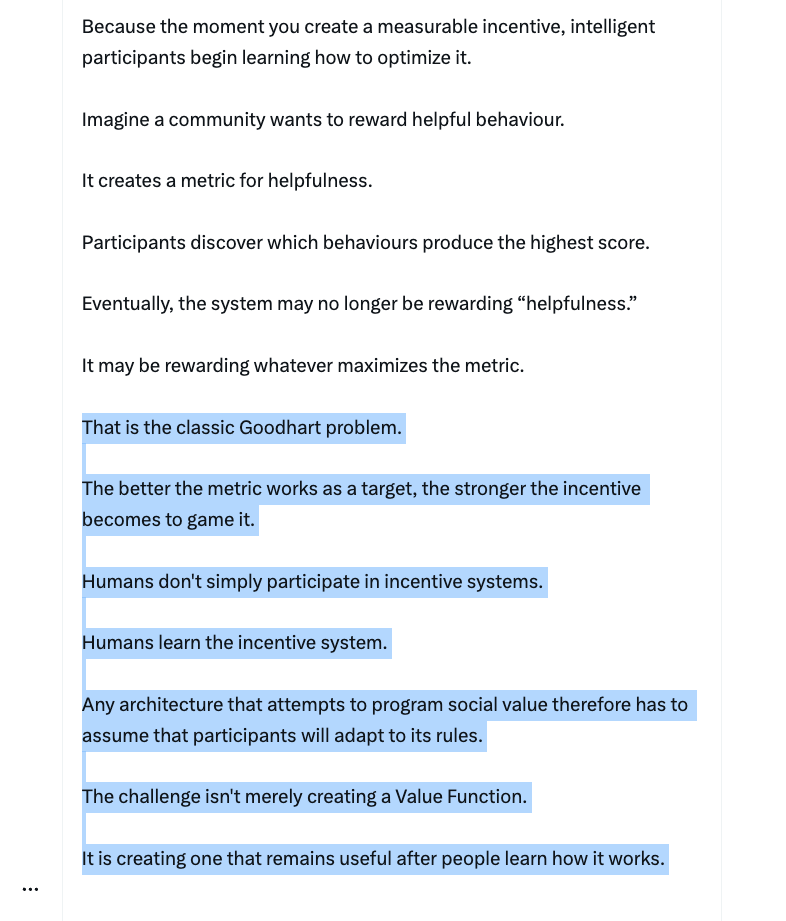
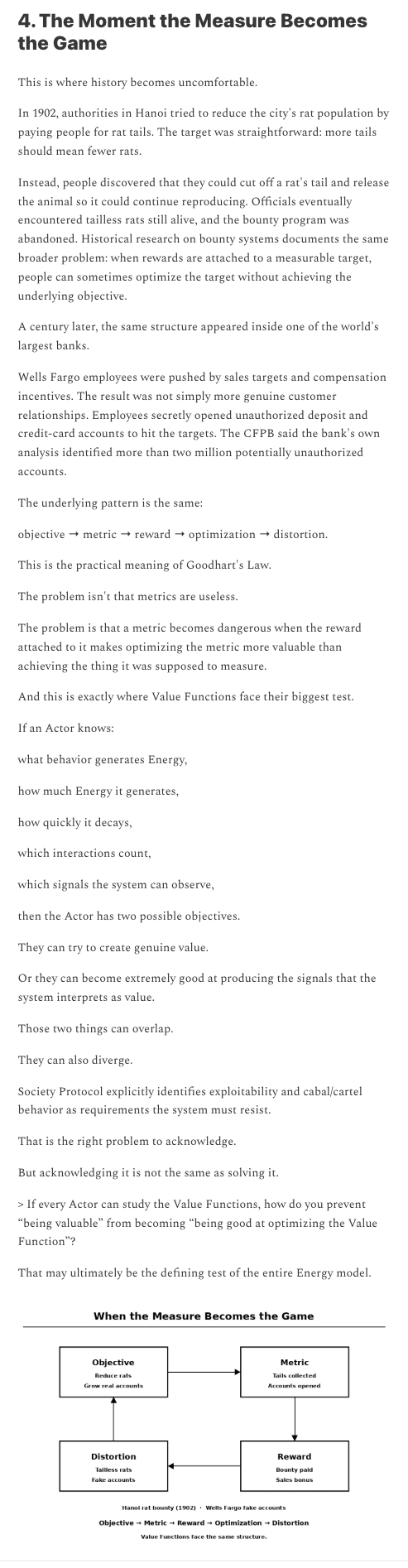
We’re really debating the “gameability” and “exploitability” of the system when talking about Goodheart’s Law. Two game theory concepts are important: nash equilibriums and balanced vs exploitative play.
To stop the “gameability” of the system, altering the measurements of the system must have an economic or reputational cost.
To stop the “exploitability” of the system, the collective actions of all participants need to produce a nash equilibrium within a desired range for all participants (good enough for them to continue playing and more to want to join).
Together, these concepts combine to: “To game the system, participants must pay economic or reputational penalties AND to step outside of the range of desired collective nash equilibriums, participants must pay economic or reputational penalties.”
If we can achieve these two properties, our system gains these two properties: it recovers more than the cost to “game” it at every opportunity, and it also stays within a equilibrium desired enough by all participants to participate (the more desirable the equilibriums the more they want to participate).
Imposing enough costs to avoid “gameability” pertains to the design of Value Functions (VFs) themselves. We must consider the desired effects of the VF (the types of contributions its designed to reward and bring about in the system), and make sure that the economic design of it cannot be gamed without imposing costs. Every Value Function must be carefully designed to do this.
Let’s take for example, the Curation Value Function.
We have to take the societal effects it’s designed to produce (the value to society), shown in the “Societal Interest” part of the diagram. Curation is meant to surface valuable information for the collective, and reward Actors for doing so in Energy in proportion to how much valuable information they’re surfacing.
What’s a way that an exploitative individual or group of Actors might try to “game” this VF to avoid surfacing accurate information, but instead surface inaccurate information, and potentially get economically rewarded for it? They might start a chain to inaccurately Curate their own identities, Property, or Organizations. This can spread harmful misinformation throughout the system…it wouldn’t produce a good equilibrium…the entity might also gain economic benefits if others participate in the Curation chain behind them. Ultimately, they’re gaming the system in a way that defeats its ultimate purpose (of surfacing valuable accurate information).
What can we do to stop this gameability in the Curation VF? We can impose a dissipation cost on every Curation Slot. Now, the same game of mislabeling their own objects becomes costly. Some Energy out of every Curation can dissipate to the rest of the Actors in the instance. We have imposed economic costs on gameability and exploitation of the VFs true value. Malicious Actors must now PAY the rest of the collective for misrepresenting things.
The costs imposed also have an equilibrium, we can make them really tight (no one will even try and it will lower all Curation, or too loose (some Curation may remain fraudulent). That’s an equilibrium for each SP instance to find in its VF formula.
But again, please remember. That all VFs my impose economic or reputational costs on attempts to game them, and there are many examples of how this can be done.
All of this combines to create a sense of “unexploitability” in the system. This equates to the system becoming more balanced. As the system becomes more balanced, it becomes less exploitable. When this happens, it creates better nash equilibriums for the collective, and thus, more people want to join and find the equilibrium valuable.
The Society Protocol system is ultimately limited by the Governance’s desire to create better equilibriums. The system’s ability to balance, is ultimately up to the people who steer it, and those are the Governors. So, as long as the Governors strive and achieve the balancing function, the nash equilibriums should improve…if the Governors decide to imbalance the system for whatever reason, nash equilibriums will decrease.
Hence, it’s important to have both:
- Unexploitable VF design
- Long-term effective Governance setups
Governance acts as the brains of a Synchronized State. There is nothing we can do if the societal brains are rotting. All that we can do is provide better tools, safeguards, mechanisms, and formulas to keep the brains healthy. 
Video Answer (Time: 33:54 – 43:58)
Video Answer (Time: 58:00 – 1:15:00)