Subject
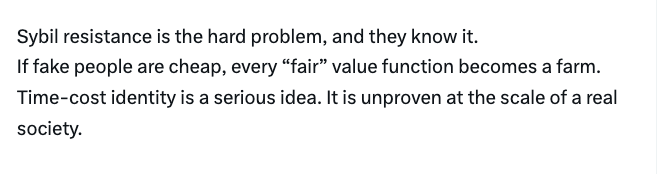
Can Society Protocol achieve effective sybil-resistance for identities?
Can its mechanisms be gamed?
What are the limitations bundled together with achieving it?
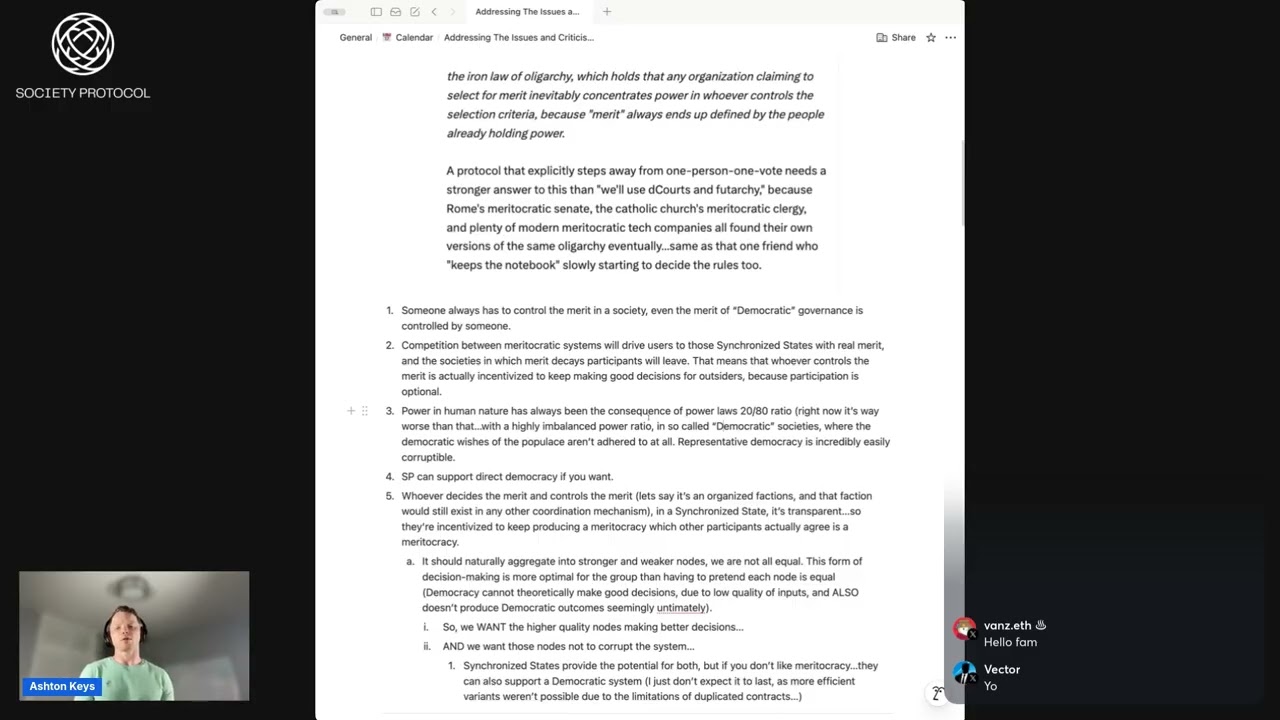
The primary innovation in Society Protocol and Web4, as opposed to Web3 structures, is that it unlocks decentralized pseudonymous sybil resistance, with absolutely no external sources needed to support the structure.
It’s groundbreaking to be able to do so, because the lack of sybil resistance online is the biggest problem facing the internet.
Society Protocol resolves sybil resistance in a very unique way, through the Hunt mechanism and Activity Scores. It’s important to understand the transition from Web3 ––> Web4, for understanding how this is accomplished.
Once we correct the flawed economic abstractions present in ALL Web3 systems, and transition to Web4 systems…the economics economic formulas inside of them get corrected, and this unlocks the door for true sybil resistance in our account structures.
It does this by treating each account differently, based on its history. The key to this mechanism in Society Protocol is Activity Scores (Contribution Scores). What each account gets is a measure of its contribution to the collective, this measure is derived from Value Functions.
The second part of making Activity Scores work, is treating accounts differently based on their Activity Scores.
Theoretically, Society Protocol instances can use Activity Scores in many ways to create differentiation between accounts (which is all that’s necessary to create decentralized pseudonymous sybil resistance).
In our current design, the only Value Function which uses Activity Scores is Hunting, to create a different tax percentage on Energy to various accounts in the system based on their Activity Scores (contributions). Hunting works almost exactly as proof-of-work (POW) and proof-of-stake (POS) systems (which also create a cost on existence of accounts in the system through inflation), with one crucial difference––it treats every account in the system differently, based on its contribution (Activity Score).
That’s the only tweak necessary to create decentralized sybil resistance in blockchain, and it requires Web4 dynamics (the correct abstraction of value).
Over time, each Actor’s account in the system will behave differently (by using various Value Functions)…this will derive a different Activity Score for each account…to make this Activity Score accumulation valuable, we give accounts with active contributions a lower re-distribuiton tax on Energy.
All that’s necessary to achieve sybil resistance with no external dependencies, is now measuring this Activity Score accurately for valuable contributions, and not allowing this metrix to be “gamed” or “exploited” by non-valuable contributions.
That’s it. Viola!
Having any amount of fake free-floating IDs in the system, deteriorates the value of the whole system. There are no “free-to-upkeep” accounts existing in Society Protocol. Through the use of the passage of time, it charges Actors on existence. This is a very natural pattern, and mimics time charging (energy) for on our existence in the universe itself. Society Protocol models a model universe, with time inside of it…as such, it’s able to enforce these dynamics to all accounts existing in the system equally.
Even if some identities can be verified…the ability to create sybils at a low cost deteriorates both the verified and unverified identities in any identity system. This effect be seen for example in a platform like Facebook or X, their inability to constrain identity creation in an effective way causes the whole platform to deteriorate.