Subject
Well, aren’t cabal and cartel formations bad? Isn’t this something Society Protocol is meant to solve?
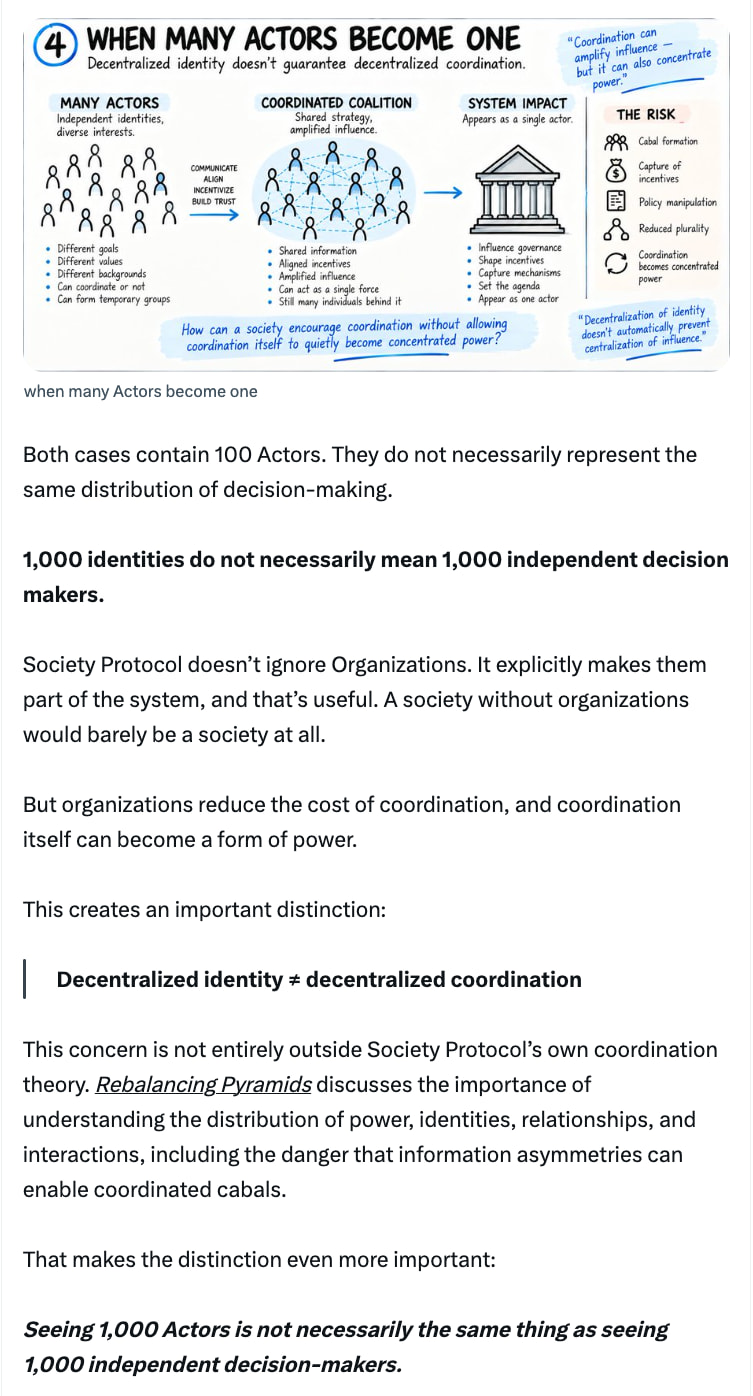
I figured out, years ago, that organized groups (political parties, cabals, and cartels) aren’t possible to prevent in any collective system. People don’t act as islands: they don’t create beliefs, vote, make personal decisions as islands.
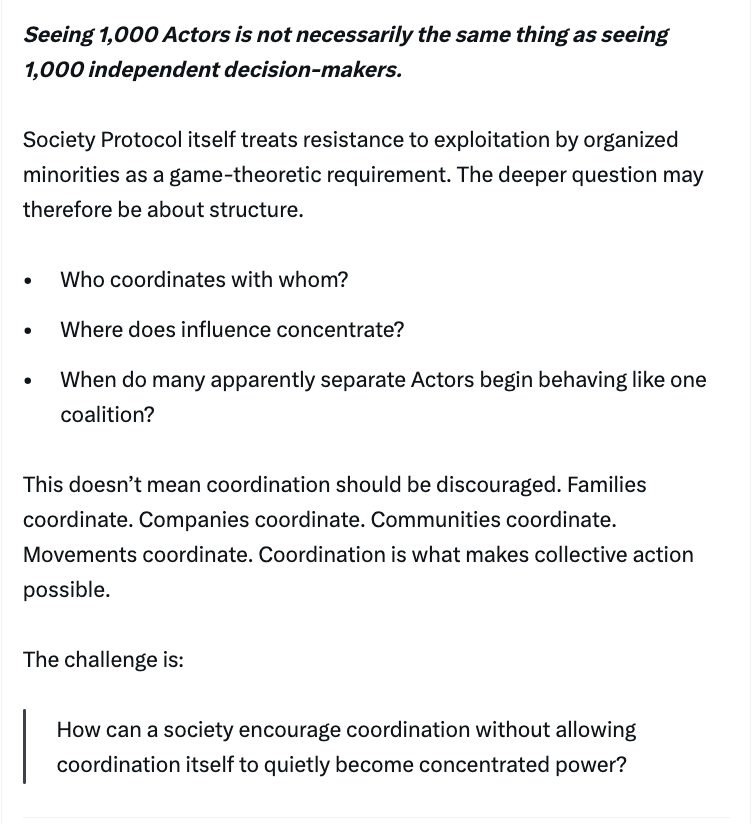
So, no matter what…a fabric of different organized sub-groups is going to form inside of any collective structure. We have to expect and understand this. Society Protocol must be designed to faciliatate this rather than ignoring or stopping it.
An importance must be placed in many cases on (organized minority groups) as opposed to (organized majority groups), because the organized majority group would simply be the will of the collective…although some safe-guards against an (organized majority) may also be valuable…but an organized minority often aims to extract resources and power from the rest of the collective (a majority has a harder time doing so…there’s more of them and less of the rest of the collective to extract from).
Without safeguards (like higher thresholds), the majority will would simply be the majority will of the collective. (We can add safeguards where these don’t align, but it must be balanced with the ability to make decisions).
What we want with organized groups, is essentially the same as with individual Actors, make sure that they’re not exploiting the rest of the collective in adverse ways, that their interests are aligned with the collective. What we don’t want, is highly organized clusters, like a cabal or cartel, extorting resources from the entire system or denying anyone else the ability to participate.
That is why the Energy system is designed the certain way that it is: where all Actors in the system can always choose to allocate their Energy to any VF, or mix of them, Governance decision mix…however they like. This places all Actors systematically on equal footing…in direct competition.
There is only one current VF which can be is adversely affected by the the dynamics of organized minorities (to my knowledge all other VFs work inversely, (all participants compete, and creating organized minorities doesn’t benefit inside the value flows of the system itself), it contradicts), and so forming an organized minority, like a guild may still be valuable outside of the system, but it would be both: competing on equal footing against the entire set of the Synchronized State’s participants AND lowering its own yields by growing.
For example, more Hunters in the system…equals less Hunt rewards for every Hunter. It makes no little sense to organize as Hunters, as each Hunter is competing with the other ones in the system on a level playing field, and organizing into an organized minority makes little sense.
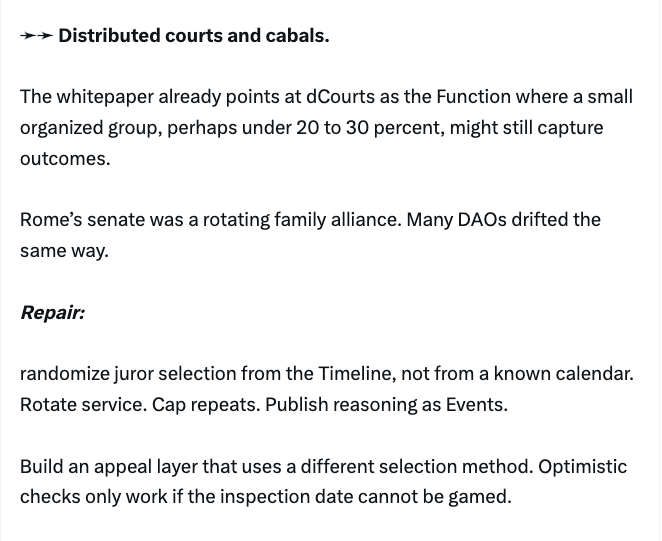
The only contradictory case to these dynamics seems to be: Distributed Courts (dCourts), it naturally forms cabals, as there’s no way to stop participants in dCourts from collaborating in a side-channel (outside of the protocol) to benefit economically.
We got around these exploitative/detrimental cabal dynamics by putting safeguards in place, called “optimistic governance,” we can essentially let the cabal run dCourts by staking Energy and making decisions (side-channels are unstoppable), but every once in a while double-check them against the wider collective, and slash Energy for the cabals divergence. So…we can still have a cabal/cartel in the system here…but to make their alignment with the wider collective harmonious.
That’s what I think will bring the most yield with these kind of things. Finding ways to align organized minorities (and also majorities to a lesser degree) interests with the whole collective. We can’t remove them–and so it’s about aligning interests.
We should focus our efforts on finding more ways to do this, it would strengthen the alignment of the Synchronized State.
There may be VF designs that seem very imbalanced (like a cabal or cartel takes control), but can be balanced out like this with this “optimistic” or similar mechanisms, where the balance remains.
Open to ideas.