My Thoughts
Most opinions on mass synchronization come from “should we do it?,” “what kinds of cons and benefits does this bring?” That is not where my opinions on mass synchronization come from.
My thoughts on mass synchornization originate from “is this the dominant coordination strategy for human tribes?”, …because if that is the case…it’s all that matters. The raw power produced by mass synchronization versus non-mass synchronization, and the cost to produce this effect, is the only important first question to answer.
To look for the value of mass synchronization throughout history, we have to look at the only known technologies which create these effects––synchornized states: the clock (1D), Bitcoin-esque blockchains (2D), Web3 blockchains (3D). The history of these synchronization devices is covered in the 4-Dimensional Synchronization (Clocks) article.
These are the only known mass synchronization devices…are they producing more value than the costs of creating and using them…are they valuable to humanity? In all three cases, the clear answer is: yes. The clock itself is arguably the most valuable technology in the world (it just doesn’t capture any of that value, but break the clocks and our society would shatter in its entirety). Bitcoin is the fastest meteoric rise in valuation in the history of assets. Web3 blockchains are poised to replace the entire traditional financial infrastructure of the world. The case for the value of mass synchronization has already been made. It’s not only valuable, it’s one of the most valuable abilities in the world.
So…if 1D, 2D, and 3D synchronization are valuable…we should assume that 4D synchronization would likewise be valuable. The vast value of all these systems is enough proof…they’re not just valuable, they’re some of THE MOST valuable and potent technologies on the planet.
The largest downside to obtaining this power, is its expensive nature. This is covered in the “Synchronization Is Valuable” section of the Synchronized States article. The value is immense, but it requires technology to unlock. So…the correct approach to mass synchronization is simply: mass synchronization valuable, but expensive…. It costs a lot of energy, and we require technology to achieve this. We start there.
So, the obvious case for mass synchronization is already made. It’s valuable, there is no denying it. The only question is “how much we should synchronize,” and, the answer to it…depends on our technological capabilities to lower the cost of synchronization + where those costs become lower than the total power the social structure gains from this. Value = benefits - costs. It’s that simple.
Now we should talk about: what would be beneficial from synchronizing versus keeping asynchronous? The answer mostly comes out the same…: whatever society finds power in synchronizing, which is more effective than coordinating asynchronously…where the cost benefits make sense?
Modern consensus engines are reaching a stage, where they’re able to able to synchronize a nearly infinite amount of Events (millions of TPS) at a low cost. This delves into blockchain architectures and combining L1 + L2 solutions, but the scale of all current (relevant to SP) human events is about 5M TPS, and we’re approaching the stage where that can be accomplished technologically (of course it would all expand from there).
The benefits to achieving financial synchronicity are apparent: collective financial intelligence, analytics, faster coordination abilities, less exploitability for the dark spots of the system (faster market balancing), etc..
The benefits to achieving social graph of interactions synchronicity are apparent: reputational clarity, historical analytics, clearer identities, better decisions for everyone involved in society (such as skipping on traffic if it’s overwhelmed), less exploitability of individuals such as human trafficking, etc…
The basic premise again comes down to…almost all forms of this synchronization are valuable, allow society to move more in lockstep and benefit everyone inside…but what kinds of expensive synchronization costs can we actually afford to bear? It’s cheaper to do all of this async.
This doesn’t mean that all of society needs to synchronize, but wherever costs drop below the benefits…it can make sense (unless another verifiable coordination form like async is more efficient). And the costs have become exponentially lowered through the past decade of blockchain technology evolution.
Society Protocol supports both synchronous + asynchronous actions stemming from Actor’s verifiable cryptographic identities.
Most private messaging, which is encrypted for example, has very little reason to be synchronized together…The bulk of societal data WILL NOT become synchronized, it will simply be anchored to the same cryptographic identity as the synchronized data. It will be more akin to the Cosmo-Localism ideas presented by Michel Bauwens––where, a lot of data is synchronized, but most of the heavy data in the world still remains retained locally.
Again, as I final point I want to stress. Civilizational coordination structures don’t care about what individuals want. Oftentimes individuals analyze these systems, from their own perspective, based off their own desires. It’s irrelevant. In fact, even if absolutely no individual in the structure may prefer this in their relative status games and desires, all can still be forced into it. It’s evolution, not desire. We must analyze these as systems of coordination efficiency, and not as a slew of individual’s opinions and desires.
Additional Notes
- Many people seem come with these assumptions that “roots and mushrooms and nature don’t synchronize…we should mimic nature in our technologies” …what? Why? How would other species in nature even mass synchronize? They don’t have the technological capacity. How would that even work? A plant would grow a part itself that is somehow connected and passing energy to other plants and all in sync? …Humans are the only known species which have the technology to mass synchronize a state.
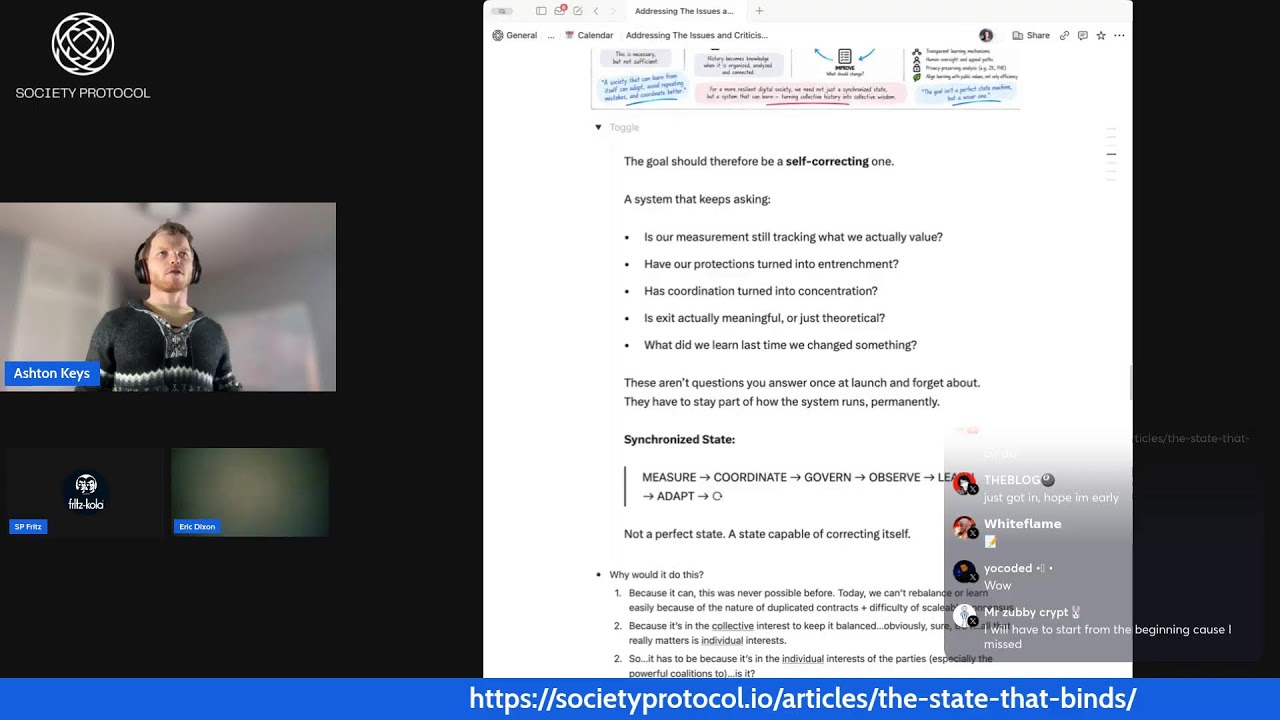
Video Answer (Time: 9:56 – 20:30)