My Thoughts
People like to call it “rules,” but governance is simply group decision-making, and I think the more appropriate thinking is "who is able to participate in making decisions for the collective, and how is decision-making power distributed.
Here’s some starting notes:
Some set of entities will always need to make decisions for the collective.
The collective ultimately wants the best decision making possible at the lowest energetic cost.
We likely don’t want the set of entities to be neither too centralized, as in the case of a monarchy OR completely decentralized, as in the case of a democracy.
Monarchy is super easy to implement, but one individual or family cannot hope to make the best decisions for the collective. Democracy is relatively difficult to implement even today (and direct democracy hasn’t even been reached). It costs a ton of collective energy across the entire society, and still fails to amount to great decision-making for the collective, because it doesn’t optimize for decision-making abilities at all, which aren’t evenly distributed, and also change across verticals.
There’s two ways to determine what best decision-making means:
- Subjective opinion of the collective
- Objective metrics the collective agrees to
So, we want to minimize energy spent, and maximize decision-making abilities.
The theoretically correct answer to this question is a meritocracy. Which is common throughout society in it’s more primitive “roles + feel” based form, but isn’t able to be scaled society-wide due to a lack of measurable metrics, automated decision-making, and ability to remove corruption of all of this in the process.
It’s not an easy feat for a scaled collective to distribute decision-making power, this takes a form of technology. Throughout history, it’s been very difficult. The entire ZEAA couldn’t scale collective at all. The SEAA was limited at monarchical vertical power structures without being able to horizontally rebalance. The DEAA is limited by duplicated contracts’ necessity to treat all parties as equals.
The Capture Question
All of this together, makes the concept of governance capture a relatively tricky one to deal with. This is because, if we don’t fully want to distribute group decision-making to everyone to begin with…what exactly constitutes capture? What makes a functional optimal meritocratic set different from a captured one?
A few heuristics come to mind:
- Is the governance set doing what the overall collective wants OR is it extracting resources from the collective to benefit itself?
- Is the governance set able to be easily exchanged and reconfigured when a better potential governance set comes along?
- (Not directly about capture but relevant to it) Is the governance set able to be judged by it’s decision-making qualities?
- Is the governance being provided at the lowest cost for the maximum possible utilitarian collective benefit?
Thoughts on Solving The Capture Question
Society Protocol provides some incredible tools, which weren’t possible before in resolving the capture question:
- The Energy system allows each individual Actor to choose how they spend their Energy, allowing anyone to potentially participate in Governance at any time, without requiring everybody to.
- Since Energy is money, we can additionally build economic incentives on whatever is considered great group decision-making right into the system. Allowing us to incorporate economic incentives to drive optimal decision making.
- The collective can make decisions instantly world-wide, synchronously in Synchronized States.
- The collective can use any form of programmable decision-making which can be encoded in Turing-complete programming.
- The immutable transparent nature of Synchronized States allow the collective to accurately perceive and track all past governance decisions, and their related metrics–allowing them to analyze things more clearly.
- The Synchronized State’s TEAA nature doesn’t need to treat each individual as equal for it to function. It can perfectly keep track of a collective of unique individuals, and allow them to sort out how they want to allocate their group decision-making, facilitating the concept of meritocracy.
- All Actor’s have equal direct access to the Synchronized State, and their decisions cannot be easily forged.
These are all very powerful primitives, to achieve the avoidance of governance capture, which is absolutely inevitable in all other systems known to man (ZEAA, SEAA, DEAA).
So, Society Protocol provides the best tools to optimally align the governance with he collective.
Since it’s difficult to exactly define “governance capture,” (because it’s not about distributing governance power wider, we wouldn’t want that…), each collective has to define it for themselves. It’s important to remember that we’re not trying to distribute governance wider, we’re trying to improve the heuristics listed above.
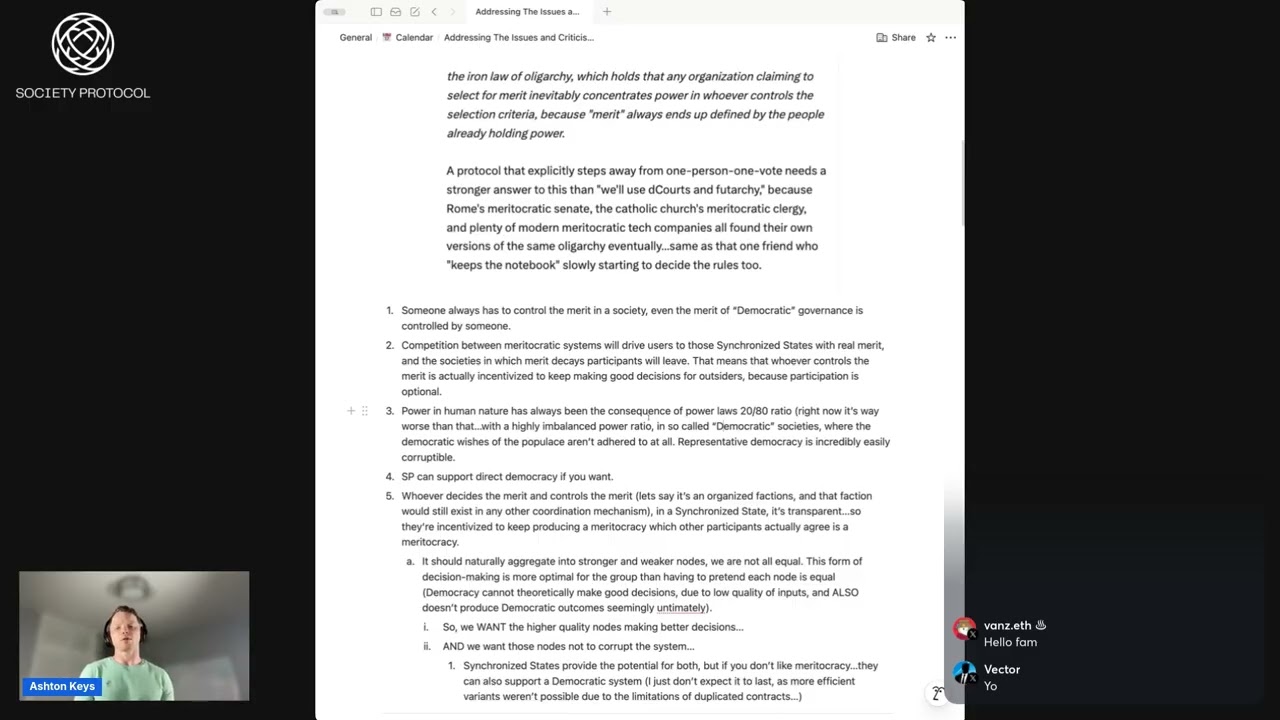
The powerful tools of being able to use the Energy system to let anyone participate in governance without requiring permission potentially AND without requiring everyone to participate equally…Alongside #1-7 listed above give people the best tools to avoid governance capture.
Video Answer (Time: 59:04 – 1:08:35)
Video Answer (Time: 2:00 – 49:43)